CINEMA: WHEN MOVIES DON'T MOVDE
The drama of stasis and “inserts”
From Nomadland. Writer-Director Chloe Zhao. Cinematography Joshua James Richards
The word movie suggests movement. The word novel might suggest newness.
The word film might conjure the stickiness of some grimy veneer.
Back to that first point. The moving movie — I’m talking of physical motion, not the evocation of emotion. Nice thought though. Movies called movies because they move us. I’ll mention one of my all time favorites: Kurosawa’s Ikiru. Now that’s what you might call a move-me.
Nor am I talking about the story always moving on, an old chestnut of screenwriting dogma — as though a film has to suffer from constant St. Vitus’ dance. It doesn’t. It can breathe, resonate, generate suspense, bask in a vibe, mesmerize, captivate.
And why can’t it be novel, and as new as a novel might be? Of course a film might seem new. Might actually be new. I’m not talking about new releases, which invariably include instances that seem far from new. I mean a movie that brings us fresh ways of engagement, of understanding, fresh natures of cinema itself.
If only we could do these films justice by calling them novels.
And are films covered by a smeary coating, or can they be luminous, in story, world, character, in cinematic language, in vision? Of course they can, even while some bear the coating of cliché.
Returning to the motion thing — before I digress too much — does a movie need movement all of the time? Is this a prerequisite?
Let’s take a minute to consider how the concept of the always moving movie can fall short, and when we might find stasis on the screen.
Eisenstein thought cinema is about montage — the juxtaposition of one image upon another.
Tarkovsky disagreed. He thought it’s about the passing of time within the shot.
Can one visionary of cinema be right and one wrong, or do we have here an antinomy — each assertion being correct but cannot be if the other also is right?
Setting aside the static emptiness of many an Ozu interior, or the montage of static spaces in a film such as Hiroshima Mon Amour (aren’t they actually stills?), unacceptable, presumably to Tarkovksy, or a “oner” movie such as Russian Ark, unacceptable, presumably, to Eisenstein — setting these aside, I want to focus, for the purposes of constraining what potentially might be a lifetime’s investigation, on the “insert shot” and what its nature or natures might be in ways that either defy or conform to any imperative of motion.
During my interview with Martin Scorsese — dependent upon which was whether I was to direct a second unit for him on Gangs of New York — one of many challenges came when the master asked me why he should give me insert shots to do—vignettes of objects and moments not involving actors—when shooting these is his favorite thing.
A light came on in the sluggish recesses of my tenebrous brain — one that was having trouble grasping it was in the same room and no more than a few feet away from the mind of such a great filmmaker: an intelligence of lightning speed and artistic bravura.
I did my best to respond. I would do my utmost to give him exactly want he wanted, I said — and that if I didn’t, I would be betraying not only him, his movie, and the task he would be granting me, if that’s what he might do, but I’d be turning my back on my own belief in cinema, which I see as devotional, which it is, as is his, (and his inspired mine). It gives me meaning, gives him meaning, probably more than it gives it to me, bearing in mind his epochal exploration of the medium.
Was it my response that got me the job, was it something else, or was it the giant’s kindness to one modest fan, something I was to experience and treasure going forward?
Whatever it was, his question — like others of his during those following precious months on the feature — was the catalyst for an exploration of mine over the ensuing years.
Why are inserts this great filmmaker’s favorite thing? He has, after all, as his editor Thelma Schoonmaker has remarked, an intuitive approach to working with actors. He has a consummate grasp of camera and cinematic language. He has a canon of work that spans the decades of my adult life.
He’s directed epic vistas of teeming humanity, brought to the screen the most wrenching dramas of violence and suffering, conjured the social interactions and conflicts of early and later gangs of New York, and Las Vegas, and of the monied classes of Edith Wharton’s literature. He’s ascended the Himalayas to journey with the Dalai Lama, sailed to Japan with a Jesuit missionary to see the man’s faith sorely tested.
And yet he obsesses over inserts?
These shots on sundry objects, small, large, man-made, from nature, perhaps including a hand or fingers passing over them but often lacking human presence, even movement, tend to be left for the end of the shooting day. (Unless there’s a second unit.) Why, after all, take up expensive time with the cast waiting around in order to capture some static, inanimate stuff of one kind or another?
And yet… they’re in the same film, aren’t they? The characters and the lifeless things of their world, its flotsam, jetsam, bric-a-brac, chotskies, artefacts, relics, and general bits and bobs of their lives — which can, despite their bloodless quiddity, carry the weight of emotion, of meaning, of mystery, and significance.
They may be comprised of the organic material of the natural world, carrying the resonance of life even when stationary, or they may be the inanimate, perhaps animated by the play of light, by passing shadows, sometimes by a camera moving over them (and thus Tarkovsky approved). Or they may be the inanimate rendered static, frozen in time, as if in a still photograph (and thus Eisenstein approved).
In the first case, the shot itself gives an energy. All part of the moving movie. In the second it tends to be its place in the montage that affords such propellant. Rhythm within the shot. Rhythm across the shots.
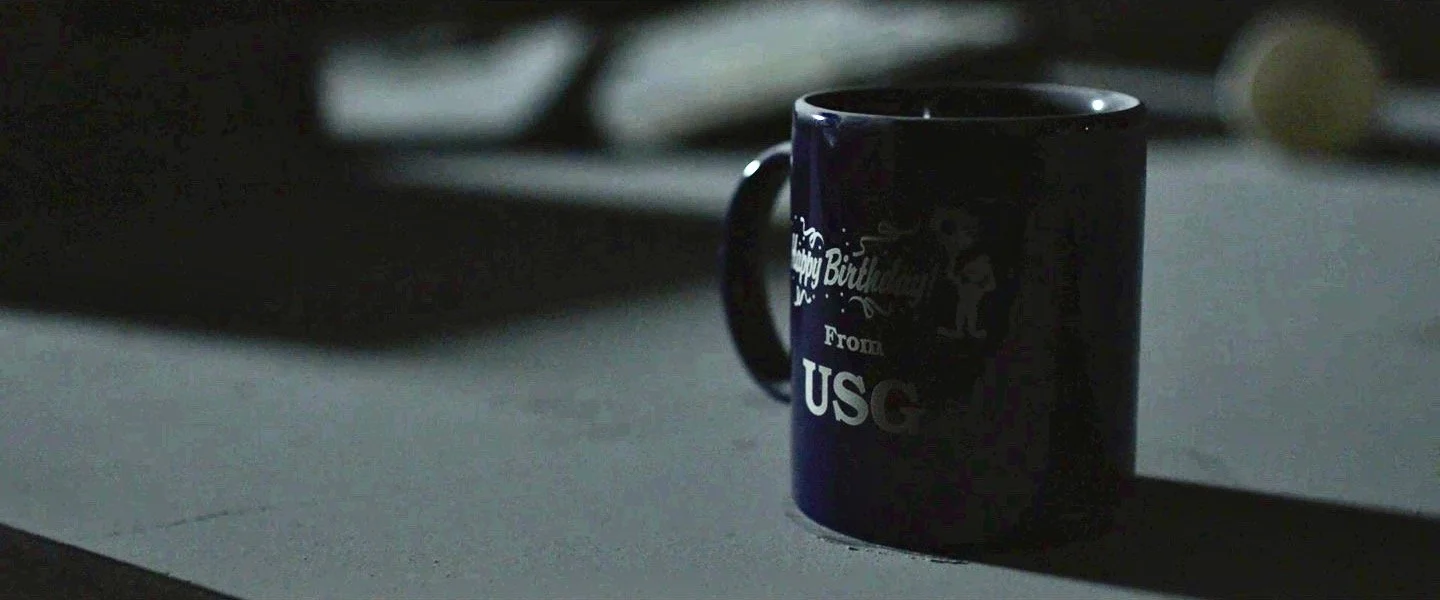
As for the latter, take some of the inserts in Chloe Zhao’s Nomadland: a blue mug, Happy Birthday from USG its inscription, untouched for who knows how long, in a deserted room in a deserted, closed-down gypsum plant — once sole engine of a town’s economy. (See the screenshot above.)
A still life. Or a life stilled, because this immobile receptacle reveals a backstory. A worker losing their job when the city of Empire’s main source of employment shut down. The stasis allows for the resonance. For the haunting. No movement, at least in the physical sense, if plenty in the emotional.
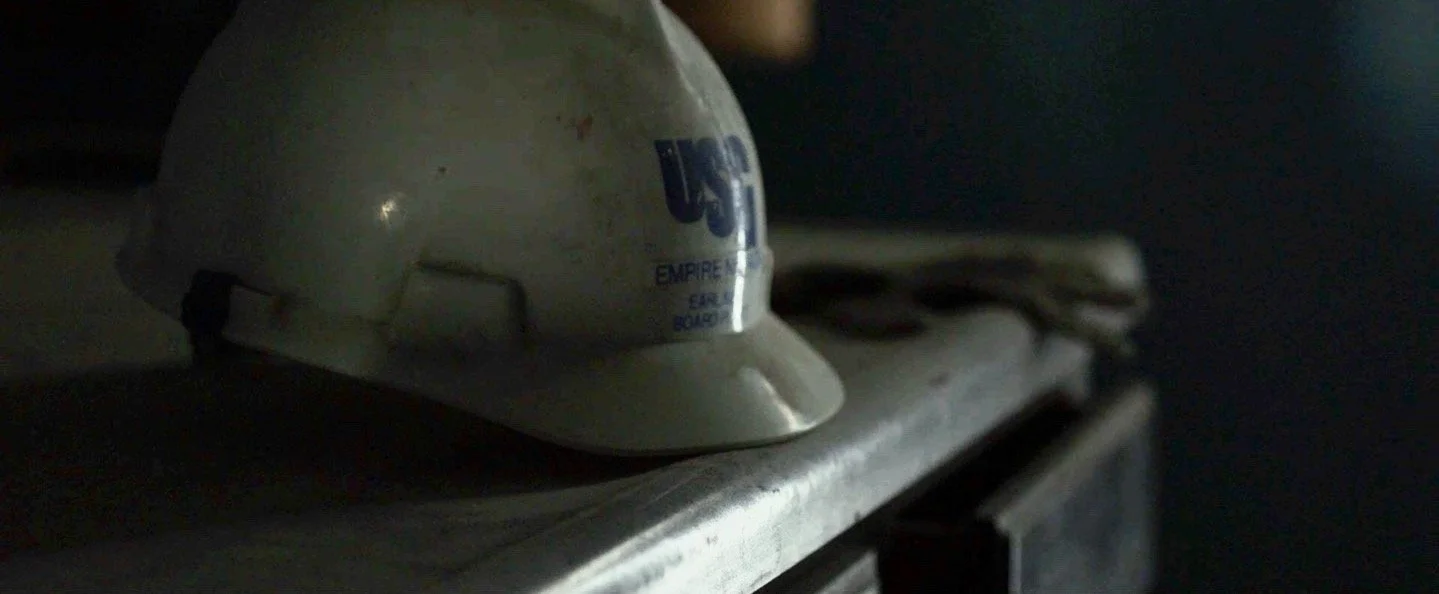
The shot is followed by a USG-inscribed grubby hard hat on a shelf. Like the mug, a visual synecdoche, perhaps. When we see that helmet on the screen, we may see, on the screen on the mind, a person wearing it, we see them making their living, laboring, grafting. Subliminally perhaps, fleetingly, subconsciously but surely for many of us: they appear.
From Nomadland. Writer-Director Chloe Zhao. Cinematography Joshua James Richards
And with the USG — United States Gypsum — insignia some of us might even see a map of the USA, and see Americans increasingly compromised, deprived, by economic adversity, by its forces and agents. Some synecdoche! Metaphor more like, symbols even: the mug and the hard hat.
What we get is so much more than what we see. Maybe it’s the same man, or woman, who drank from the mug. Perhaps another of their now unemployed co-workers. Whatever, the shot has one presence on the screen, and another in the mind.
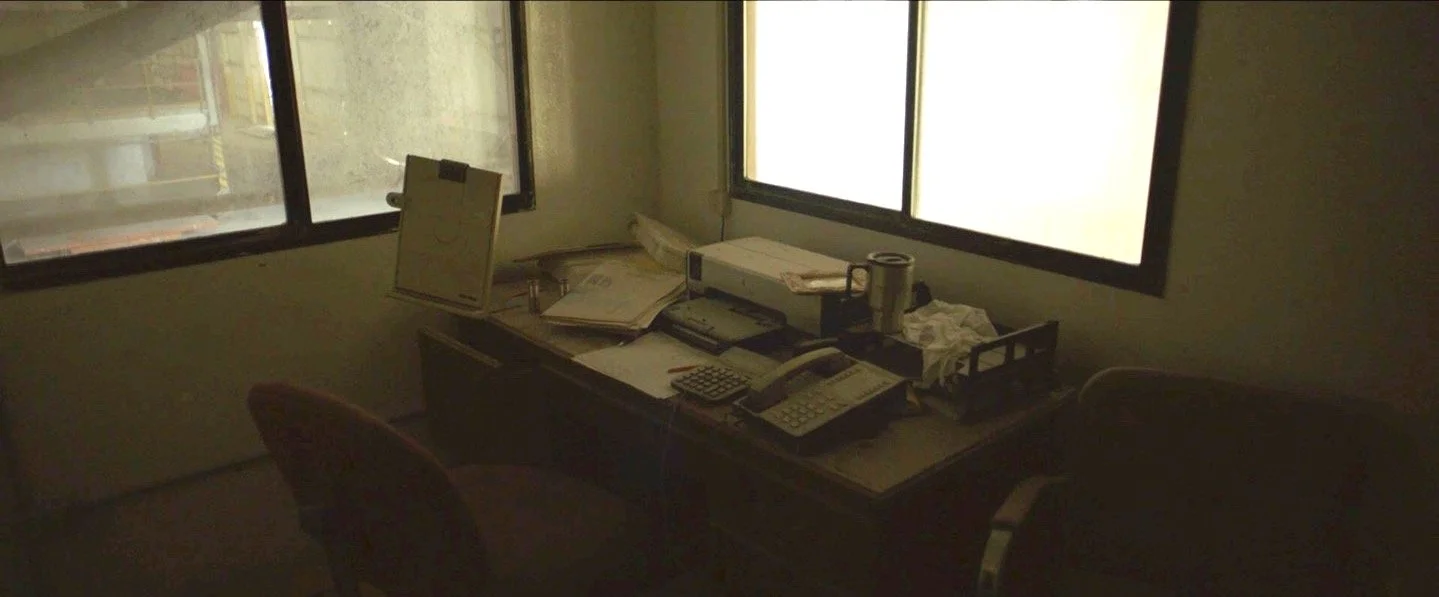
Then comes a shot of an office. Still, static. No shift of light. No sound.
From Nomadland. Writer-Director Chloe Zhao. Cinematography Joshua James Richards
Protagonist Fern is paying a visit to her dead husband’s workplace, wandering through its spaces, its rooms, but we are not seeing her there. Is she present? Are we sharing her POV? Are we sharing her POV? Or are we privileged with our own journey and perception? We need no clarification. The reverberations of loss, of a vanished past are enough.
We see objects. We see emptiness. A disintegrated fabric of a society fallen foul of economic currents. (And all of this prompted by a comment from the actual caretaker of the plant to the effect that it was as if it were frozen in time — words that Zhao leaves in her screenplay but transforms into cinematic language for the screen).
How could these shots be included in a movie — a moving picture, to give the original term?
This movie has become a stillie.
(Chris Marker’s La Jeteé consists of a series of stills — how does this render it a movie?)
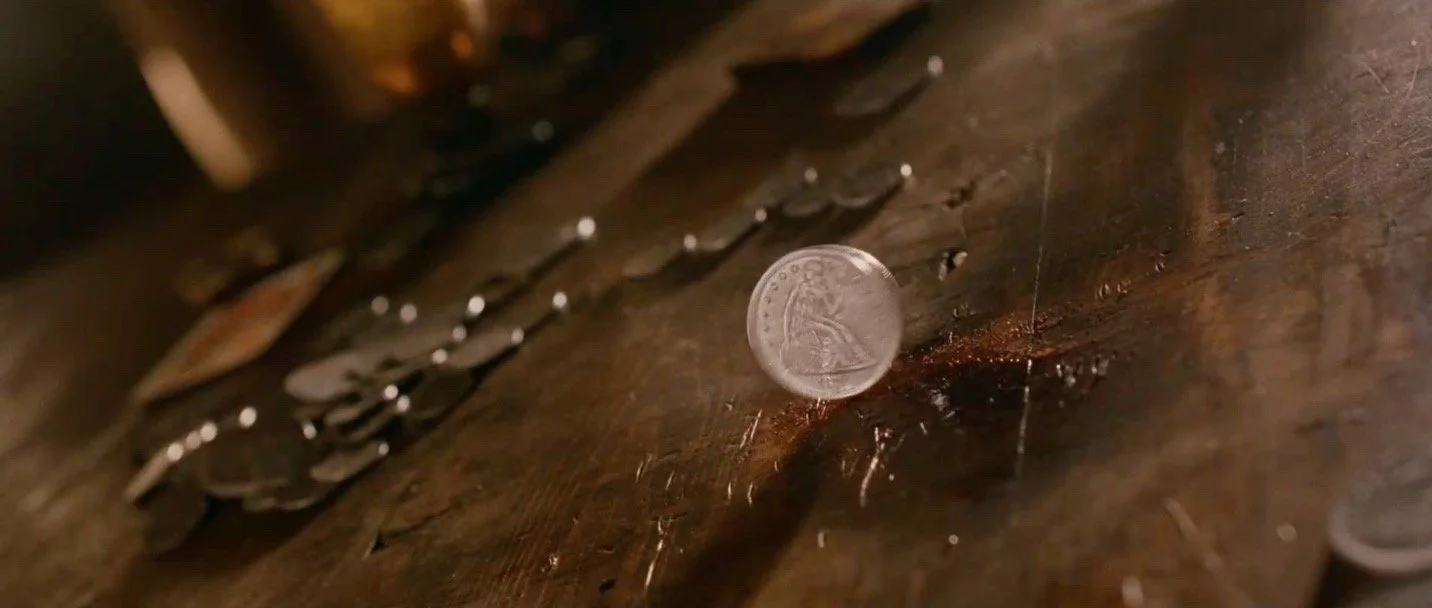
The discourse of film is not action alone then? Inserts can of course involve action, can be animated, as previously described. They can include a human presence. A hand reaching in. A foreground wipe. Some of what I was to do on Gangs were examples of such. Heirlooms on the floorboards of a burning house as flaming debris falls on them. A rolling pistol ball fresh from the shoulder of Bill the Butcher. A bloodied vest torn open. A spinning coin on a bloodied gambling table…
From Gangs of New York. Martin Scorsese. Cinematography Michael Bauhaus.
The unmoving frame though, can work on a grander scale altogether…
Here’s an example from Oliver Laxe’s Sirāt. Speakers lined up for a desert rave. A second of stasis only on the screen perhaps, before Laxe cuts in to dolly along the edifice, but all the more startling for that:
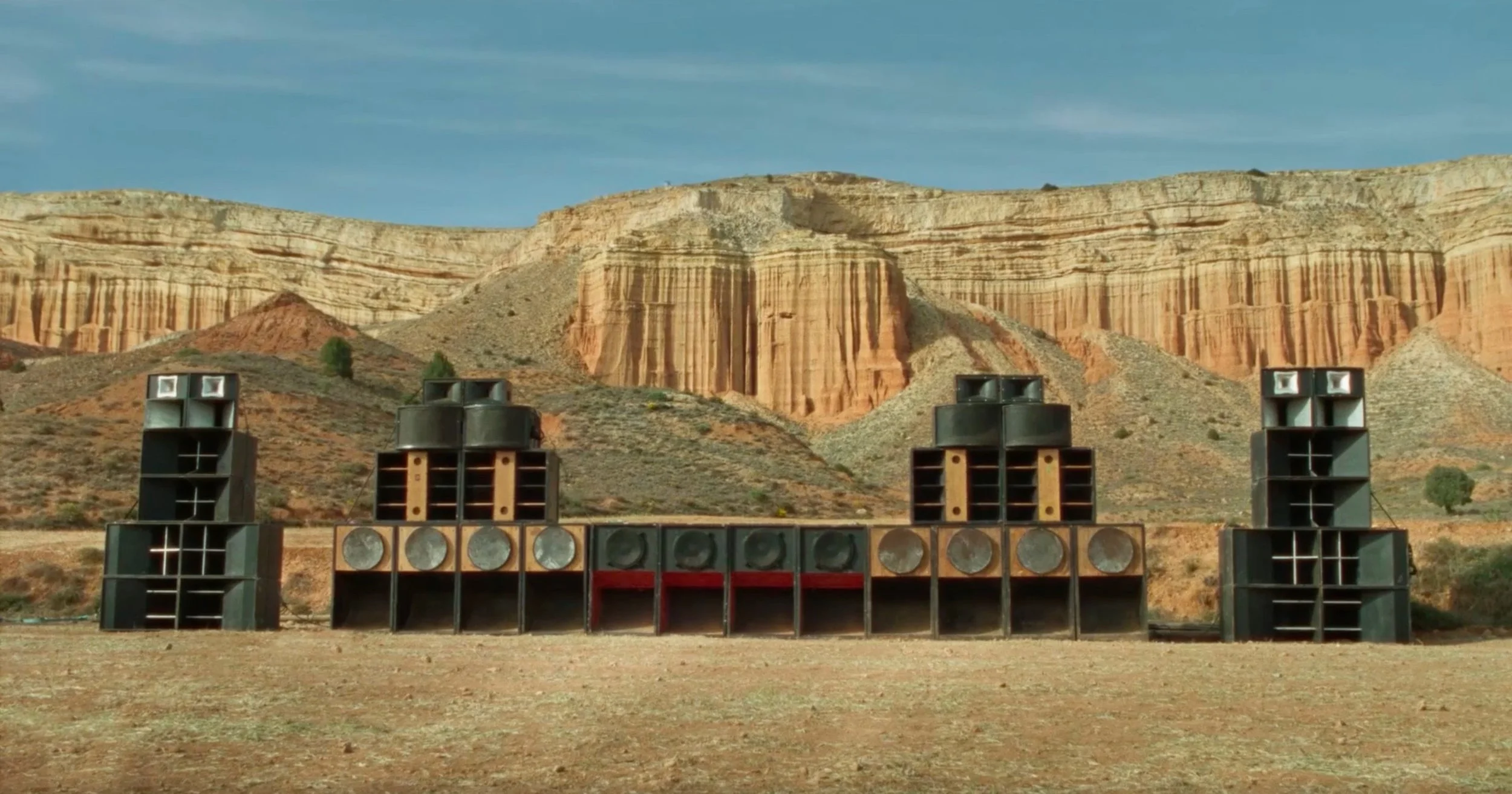
From Sirāt. Co-Writer-Director Oliver Laxe. Cinematography: Mauro Herce.)
The man-made and the natural. The present day and the primordial. Human and planet. The manufactured and the eroded. The transient, the permanent. Time and timelessness. The sound to come and no sound to come. Silence, and silence to be interrupted. The promise of dance, the backdrop of fixity. The lateral, the vertical. Land, sky. Rock, metal and wood. Two geometries — the designed, the random. Each antithesis the stronger for the stasis of what we see and the stasis of how we see it.
In this road movie, with restlessness, seeking, desert- and mountain-crossing to follow, and very much the fluid action of the movie, such a static image — echoed by “insert shots” of lone speakers solitary in the desert toward the end of the film — such a picture of the inert plants an anchor the ensuing movie is to rip from its mooring.
Energy, rhythm, flow, breath, punctuation, emotion, along with story and vision, these are the criteria of cinema. Not movement alone. Objects and things as fabric of a world, encapsulation of the human, of the non-human, the organic and inorganic, as declaration of indifference, of dissonance, as relic of what has been lost, as backstory, as critical comment, sometimes simply, simply as thingness…
The unmoving, set against the moving.
Yes. Let’s go to the unmovies!
Thank you for reading.
Peter Markham
January 2026